
Qtech as eInvoice Service Provider (ESP) for BIR's EIS program
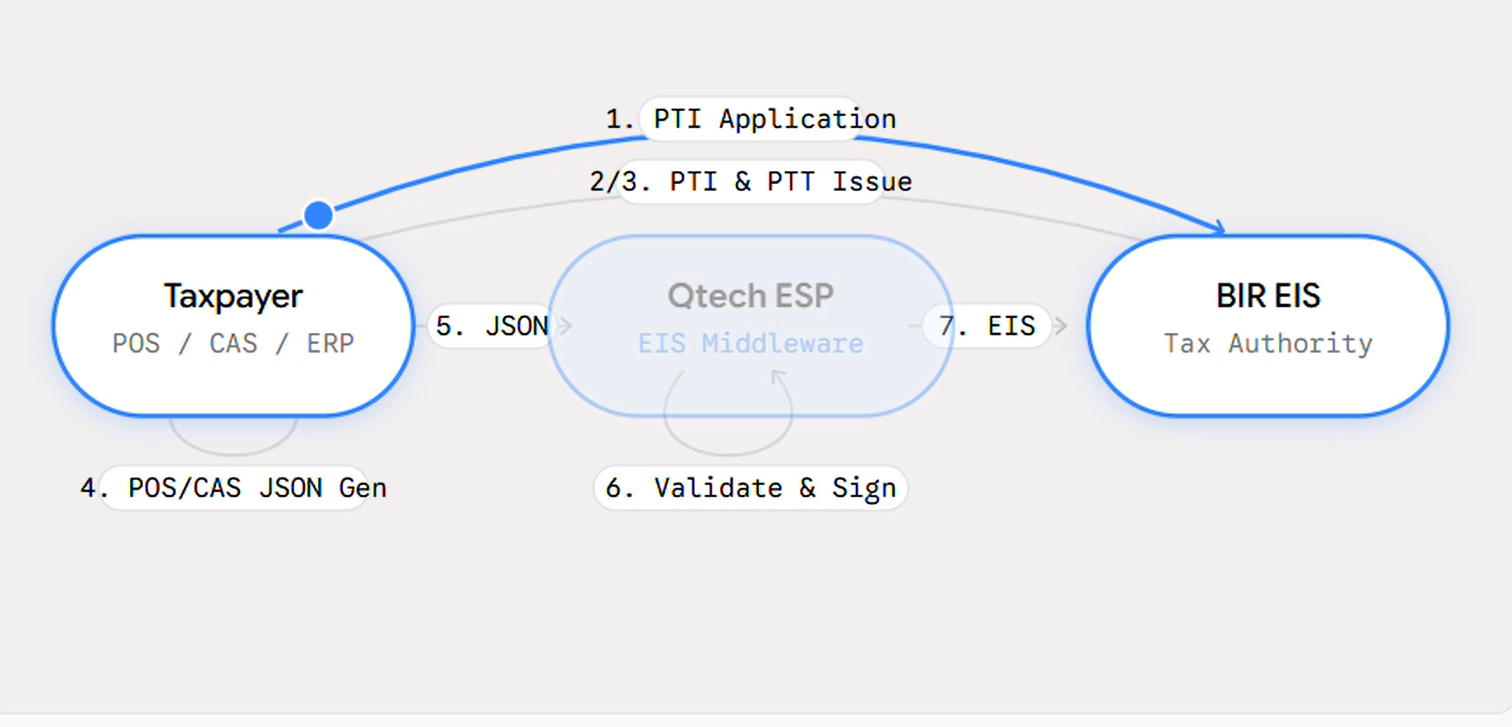
Qtech's new ESP Utility serves as an automated middleware solution to help covered enterprises seamlessly transition to the BIR’s mandatory Electronic Invoicing and Sales Reporting (EIS) framework by the December 31, 2026 deadline established under RMC No. 98-2026. By automatically validating and converting invoice data from existing CAS or POS systems into the prescribed JSON format, the utility securely transmits the required electronic data directly to the BIR, ensuring full tax compliance without forcing businesses to overhaul their current software operations.
Qtech Launches ESP Utility to Bridge the Technical Gap for BIR E-Invoicing Compliance
Qtech has officially launched its Electronic Invoicing Service Provider (ESP) Utility, a specialized middleware solution designed to help Philippine enterprises transition to the Bureau of Internal Revenue's (BIR) mandatory electronic invoicing framework. The new service directly addresses the technical integration gap faced by taxpayers mandated to adopt the Electronic Invoicing and Sales Reporting (EIS) system under Revenue Regulations (RR) No. 11-2025, as amended by RR No. 26-2025.
Under the policies and guidelines prescribed in the document RMC No. 98-2026 redacted.pdf, covered taxpayers are required to issue electronic invoices and comply with the provisions on or before December 31, 2026. This mandate applies to a specific set of taxpayers: those engaged in e-commerce or internet transactions, taxpayers under the Large Taxpayers Service (LTS), entities classified as Large Taxpayers under the Ease of Paying Taxes (EOPT) Act, and businesses currently utilizing Computerized Accounting Systems (CAS) or Point-of-Sale (POS) systems.
A primary challenge for these businesses is meeting the strict technical criteria for what constitutes a valid electronic invoice. The regulation mandates that the invoice must be generated in a structured electronic format and contain data capable of being electronically extracted, processed, and transmitted to the BIR. Specifically, the BIR's EIS prescribes the JavaScript Object Notation (JSON) file format for transmitting sales data. Invoices manually created using standard office productivity applications (such as Microsoft Word, Excel, or Google Docs) do not qualify as valid electronic invoices for tax compliance purposes.
To solve this operational bottleneck, Qtech’s ESP Utility acts as an automated API bridge. An ESP is defined as a juridical entity organized in the Philippines that provides e-invoicing, sales reporting, integration, validation, transmission, and audit-support services to taxpayers. Leveraging its extensive experience as a BIR-accredited POS and CAS provider, Qtech's utility receives the generated invoice data directly from the business's existing software, validates its structure, converts it into the prescribed JSON format, and securely transmits it to the BIR's EIS platform.
By implementing Qtech's middleware, businesses can avoid the cost and downtime of overhauling their core retail or accounting software. Instead, they can focus on securing their required Permit to Issue (PTI) Electronic Invoice from their Revenue District Office and passing the online testing for their EIS Certification, while relying on Qtech's ESP Utility to handle the complex backend data transmission to the government.